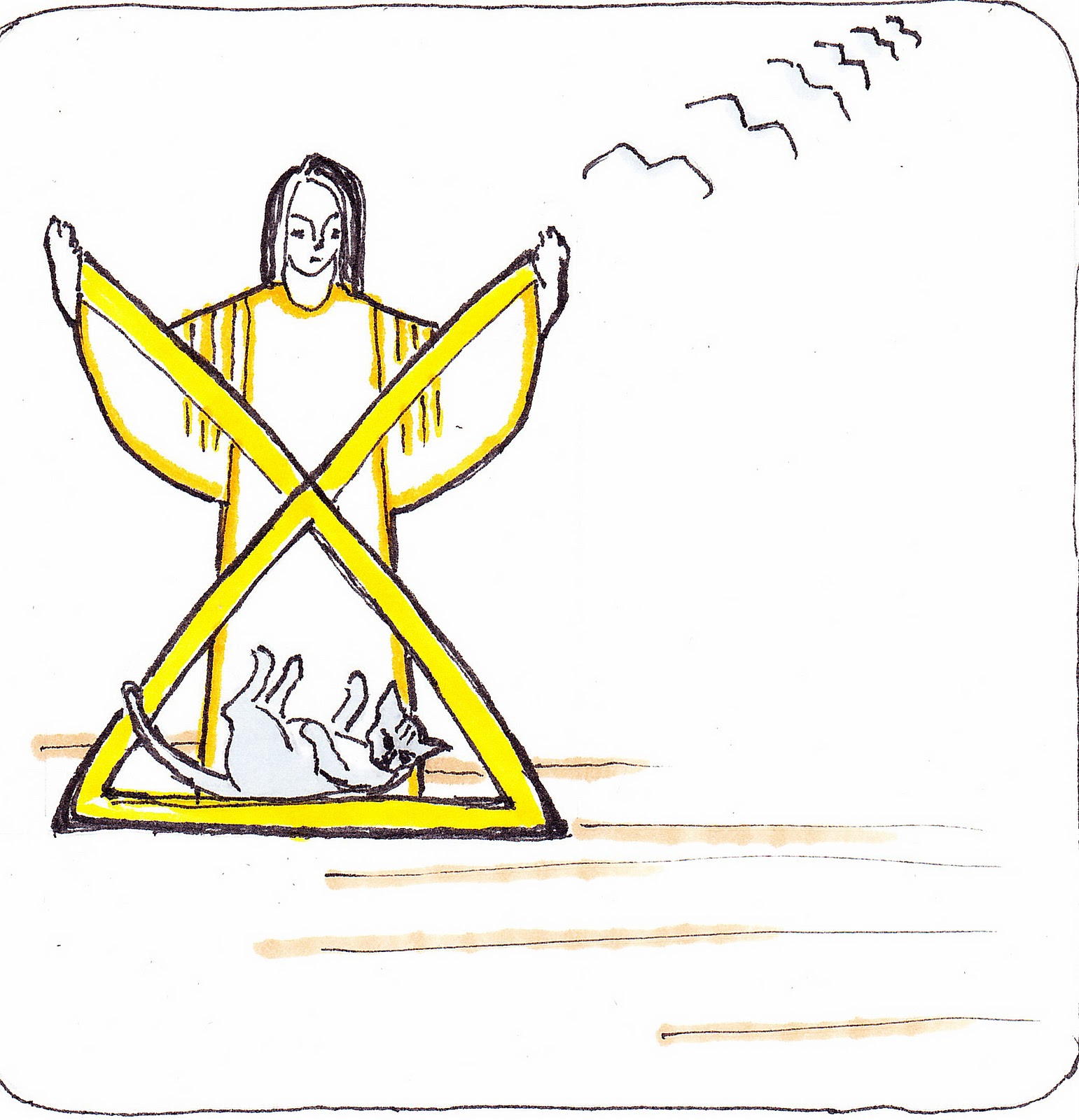
We Catalans have always been a hairy people, so it's not surprising that we owe our flag (la senyera) to a 9th-century count of Barcelona named Wilfred the Hairy (Wilfred el Pilós). The story is lost in the mists of time, and historians love to poke holes in it, but we Catalans love to tell it.
It seems that Wilfred was helping the king of France, Charles the Bald--or perhaps his son, Louis the Stammerer--in a battle against the Visigoths (or perhaps the Moors). With Wilfred's help, Charles (or Louis) won the battle, but Wilfred was wounded.
The King wanted to show his gratitude, and Wilfred asked him to put a mark on his coat of arms, which was plain gold. With a sense of the grand gesture, Charles (or Louis), dipped four fingers in the blood of Wilfred and dragged them from top to bottom of the coat of arms. And that is how la senyera, also known as the four bars of blood (les quatre barres de sang) came about.
If you have watched Catalans marching and voting for independence in recent weeks, you may have noticed, in the ocean of waving senyeres, people holding up their hands with four fingers extended. They are duplicating the gesture, thirteen centuries old, of Charles the Bald (or maybe Louis the Stammerer) on the coat of arms of Wilfred el Pilós.
Most news reports attribute Catalans' desire for independence to financial matters. And it is true that Catalans pay the highest taxes in Europe and get precious little of that money back from the central government in Madrid. But it is much more than that. The secessionist impulse is based on a deep sense of separate identity, an identity whose clearest emblem is the Catalan language.
No one understood this better than Franco, and after winning the Spanish Civil War in 1939 he immediately forbade the use of Catalan in public fora. My generation was not taught to read and write Catalan in school; we did not see it in newspapers or street signs, or hear it in church or the radio or anywhere outside of home and the corner market. Franco imported the dreaded Guardia Civil from other parts of Spain to keep order in Catalonia. The guardias did not speak Catalan, and when addressed in the language would bark, "hablad cristiano!" (speak "Christian").
When Franco finally died in 1975 and Catalonia was granted a certain degree of autonomy, there was an explosion of feeling for all things Catalan, but especially the language. I have never known a population so obsessed with their native tongue. In a vegetable market in Barcelona in the early 1980s I overheard two old ladies, their net bags overflowing with the day's shopping, arguing about the proper Catalan term for "carrot," whether it was pastanaga, or safranòria.
So the Catalan desire for independence is not just about money, but also about history, tradition, language...and something else. It's an attachment to that fertile triangle tucked between the Pyrenees and the Mediterranean and coveted in turn by Greece, Rome, the Arab caliphate, and France, not to mention Spain. It's about the human towers wobbling against the sky, the geese in the cloister of the Barcelona cathedral, the sardana (as different from flamenco as a dance could be) danced by young and old on the city square. And through it all flows the sound of the language, long forbidden and reviled and all the more loved for that.
I heard a young Catalan on the radio today. "Why are you for independence?" the interviewer asked. "It's not the money," he answered. "It's more than that. I don't know. It's just a...a...It's a feeling!" he concluded, triumphantly. Many listeners probably found him inarticulate, but I know just what he meant.
Showing posts with label Catalan. Show all posts
Sunday, October 8, 2017
Monday, September 19, 2016
Fun with Foreign Languages
My mother
was a born adventurer, a conquistadora ,
the first female ever to leave her village in quest of higher learning in
Barcelona. But after she married the mindset
of the era caught up with her and she gave up her studies and settled down to
making my father happy and being a good mother.
She supervised
the maid, mended socks on rainy days, went to lectures and art openings, argued
with her sisters, and read. But her
wanderlust kept her restless and frustrated. When it came time for me to go to
school she looked at the convent schools for girls and found them tame.
Besides, they all taught French as a second language, and France was hardly
exotic, being practically next door, just across the Pyrenees.
Then she
heard about a new school run by German nuns, and her imagination caught fire.
Germany! Those deep pine forests, the men in strange leather shorts, that
fabulous snow—here was weirdness and the promise of mind-expanding adventures,
especially since the nuns, who barely spoke Spanish, promised to have me
speaking German before I reached puberty. This, my mother hoped, might qualify
me to marry an ambassador some day, and help to make peace in the world.
But neither
my mother nor the nuns realized that a state of terror interferes with
learning, especially learning a foreign language. My German nuns, survivors of the Reich, were
fiercely devoted to discipline, punctuality, and standing up straight. In their hilariously inadequate Spanish they
would shriek strange insults at us. Eres
mas tonta que la noche! (You are dumber than the night!) was a common
reprimand that made no sense to us Catalans, who associated night with the
scent of jasmine and the trill of the nightingale.
In that
atmosphere, I found German grammar even more impenetrable than math. Der,des, dem, den; die, der, der, die...
no matter how well I memorized them, declensions made no more sense to me than
lowest common denominators.
Fortunately,
after almost five years of this, my mother’s wanderlust freed me from my
struggles with German. My father was offered the chance to go to Ecuador as part
of a string quartet; she urged him to accept; and when I was ten we
left Barcelona for the wilds of South America.
In Quito, she
enrolled me in a school run by Spanish nuns for the daughters of the Ecuadorian
aristocracy. There I was instantly branded as la españolita, the little Spaniard, because of the way I spoke.
Although my classmates and I shared the same language, my Castilian Spanish was
the equivalent of British English, and I must have sounded foreign and affected
to them. It took me about a week, in self defense, to shed my accent and sound
like a local, incorporating not only their pronunciation, but also native
Quechua expressions: arrarrai (hot), atatai (disgusting), achachai
(cold).This appalled my parents, who thought I was prostituting my national
identity. But I had to fit in somehow.
Meanwhile,
the river of Catalan in which I had used to swim in Barcelona shrank to a narrow
stream. My parents and the other three members of my father’s string quartet
all spoke Catalan, but everyone else—the maid and the vegetable seller and the Indian
man who sold us milk from his cow--all spoke South American Spanish. To my
Ecuadorian classmates, I was the little Spaniard, period, and they didn’t know
or care that I wasn’t really and truly Spanish, but Catalan.
In my new school
there was a teacher from Germany, a tall, thin man who, thank heavens, taught only
English. After the rigors of German grammar, the apparent simplicity of English
was balm to my brain. After class I would mumble bits of phrases to
myself: Little Miss Muffett/sat on a
tuffet/eating of curds and whey. Tuffet,
curds, and whey were mysteries to me, but they sounded cool. English was cool, and I thought I had just
about mastered it.
When my parents and I landed in
the wilds of Birmingham, Alabama, in 1958, the
confusions about where I came from and what my “real” language was continued to
dog me. In the
Catholic high school that I entered as a freshman some of my classmates weren’t
too certain of where Spain was on the map, and what distinguished it from, say,
Mexico. When people assumed that my native language was Spanish, I tried to
explain that it was Catalan.
“Oh, you
mean a dialect of Spanish?”
“No!” I
would shriek. “Not a dialect! A different language! A completely different language!” And they would shrug and turn away,
baffled.
After a
while, I stopped explaining, and let my friends assume that Spain was a
homogeneous culture where everybody spoke Spanish, played the guitar and danced
flamenco. At home, though, with my parents, I spoke Catalan. The river of language had shrunk to the
merest trickle, but it still flowed where it mattered.
At least for
a while. Then in 1960 my parents, who had long been disappointed in their hopes for a
large family, produced another baby. I was sixteen when she was born, and as delighted as my parents were. Undeterred by the fact that Americans
found my name, Eulalia, unpronounceable, my parents proudly gave my sister another weird
but thoroughly Catalan name: Nuria, after a valley in the Pyrenees.
Where
language was concerned, however, they were more pragmatic. As an American, my
sister would need to know English, but learning Catalan as her second language would
take up precious space in her brain. Spanish would be far more useful, and
therefore they decided that we should switch from speaking Catalan to Spanish
at home.
This threw
me into fits of adolescent rebellion. Although I had all my life
spoken Spanish to non-Catalans, I could not
bear to even think of speaking it to my parents. It felt artificial, affected, false,
pretentious, and profoundly embarrassing. But my parents were adamant, so I
compromised. If my sister was in the room, I spoke Spanish. But
the moment she toddled off and I was left with my parents, I would switch to
Catalan, even in mid-sentence. When she
toddled back in I would clench my teeth and go back to Spanish.
My parents
also decreed that, since my English was better than theirs, I should speak to
Nuria in English, so when I was alone with her that is what I did. To this day,
even though she speaks it well, I don’t think my sister and I have exchanged a
single sentence in Spanish.
That is how
the trickle of Catalan slowed to an occasional drop. After my father died, it
became a language that for many years I spoke only with my mother. Now that she
is gone, I almost never speak it. On the rare occasions when I do, the words
feel like stones in my mouth.
Labels:
Alabama
,
Barcelona
,
Birmingham
,
Catalan
,
Catalan identity
,
convent schools
,
Ecuador
,
English as a second language
,
foreign language learning
,
German
,
nuns
,
Quito
,
women's roles
Friday, September 9, 2016
River of Words
I was too
short to reach the faucet, so to ask my mother for a glass of water, I said “un vas d’aigua, si us plau.” But if I
had to ask the maid, I said instead “un
vaso de agua, por favor.” Somehow I knew to speak to my parents, my aunts,
and my grandparents in Catalan, a Romance language born of the sloppy Latin of
the Roman soldiers who occupied the northeast of Spain. But to speak to the
maid, who came from the south, I used Castilian, another descendant of bastardized
Latin.
When Ferdinand and Isabella unified the various kingdoms of the Iberian
peninsula in the 15th century, Castilian, known in the rest of the
world as Spanish, became the official language of the new country, and a centuries-long
suppression of regional languages such as Catalan and Basque began.Growing up
under Franco’s dictatorship, my generation wrote and spoke Spanish, which was enforced
as the language of public life, more correctly than Catalan. But for all his
efforts to eradicate it, Franco could not erase Catalan from the dining room
table with its cruet of olive oil and its bottle of dark red Priorat, or from
the bedtime stories, the nightly prayers, and the lullabies.
Although as
a toddler I didn’t think much about the difference between Spanish and Catalan,
I was acutely aware of the distinctions between barceloní , the variety of Catalan spoken in Barcelona and by my
father and his family, and lleidatà,
the variety spoken in the province of Lleida, a mere eighty miles away, where
my mother came from. Although as a city kid I should have spoken barceloní, my heart belonged to the
horses, pigs and chickens, the wheat field and the grape arbor of my maternal grandparents’
farm, and I proudly spoke a countrified lleidatà.
But whether barceloní or lleidatà
, I spent my childhood swimming in a river of language that flowed over and around
me and sometimes threatened to engulf me.
If you had asked me in my earliest years what adults did, I would have
answered that they talked. At our house the radio was only turned on for selected
programs, and there was no television. So people talked, all day and far into
the night, as a kind of sport.
My mother
and her sisters talked while they mended their stockings, ironed their blouses,
or braided my hair. If one of them gave an opinion, the other countered it. If
one told a story, the other corrected, expanded, and topped it with an even
better one. When my father came home from rehearsal at the Liceu, the Barcelona
opera house, he told us about the fabulous all-Black American company that had
come to perform Porgy and Bess, or
the amazing ballerina Maria Tallchief--also American, and a real Indian. Back
from the bakery with the midday loaf of crusty bread, the maid relayed what she
had heard the baker’s wife say as she stood in line.
After the
meal I would sit on my mother’s lap while the adults lingered at the table,
talking. With my head on her chest I could predict by her intake of breath when
she was about to say something. I couldn’t understand what she was saying, but
I knew if she was feeling excited or angry by the rhythms of her breathing and the
resonance of her voice inside her rib cage—the same rhythms and sounds that had
lulled me during the nine months I had inhabited her body.
Words, followed
by sudden pauses and then more words, swirled around me as I drowsily pressed a
moistened fingertip onto the tablecloth to pick up the last crusty crumbs of
bread. People gestured and exclaimed, burst into laughter, interrupted and talked
over each other. This was not considered impolite, but rather a sign of
interest and engagement. Failure to participate
prompted anxious inquiries: “You haven’t said much. Are you coming down with a cold? You should
have worn a sweater this morning. Let me feel your forehead...” (To be continued.)
Labels:
bilingualism
,
Castilian
,
Catalan
,
Catalan food
,
childhood memories
,
conversational styles
,
language learning
,
Spanish
,
Spanish history
Wednesday, October 30, 2013
"Spanish": A Rant
O.k., here is a rant I've been repressing since the fall of 1958, when I first landed on these shores.
It has to do with what Americans mean when they say that someone is "Spanish." It used to be that when people would tell me "Oh, I used to know a Spanish boy in high school," I would ask what part of Spain he was from. And invariably it turned out that the person was Cuban, Mexican, Dominican, Nicaraguan, Honduran, Panamanian, Venezuelan, Colombian, Ecuadorian, Bolivian, Paraguayan, Uruguayan, Chilean or Argentinian. But never, not once, was he Spanish. He spoke Spanish, or some version of it, but he was no more Spanish than someone from Kansas is English.
Now, when I'm told that someone is Spanish, I just nod. It's highly unlikely that the person is from Spain--after all, there are only forty million of us, as opposed to some five hundred million Spanish speakers south of the Rio Grande. Spanish people come from across the Atlantic. We are Europeans, and though we share certain cultural and linguistic features with Latin Americans, we are as different from them as a Californian is from a Yorkshireman. Not better, not worse--just different.
Latin Americans in the U.S. have introduced the word "Latino," which is short for latinoamericano, to describe their origins. Of course "Latino," absent the americano part, is also inaccurate, since it necessarily includes people from Spain and Portugal, who were conquered by the Romans before they, in turn, conquered the New World. But I've quibbled enough.
And here is a sub-rant, about the Castilian and Catalan languages, which are often confused. Until the fifteenth century, Spain consisted of a number of separate kingdoms, each of which had its own language. Then Ferdinand of Aragon and Isabella of Castile married, subjugated all the kingdoms, and imposed Castilian as the official language of the new country. So what is generally called "Spanish" is actually the tongue originally spoken in the central region of Spain.
But the other regional languages--Aranese, Basque, Galician, Aragonese, Asturian, Leonese, Cantabrian, Extremaduran, Eonavian, Fala, Riffian, Calo and my own native tongue, Catalan--are alive to this day, despite centuries-old efforts at suppression by the central government. With the exception of Basque, whose origins nobody has figured out, they are all Romance languages and not dialects of Castilian, but languages in their own right, just as French, Italian and Portuguese are.
And finally, a sub-sub-rant, about the supposed "lisp" of Castilian speakers which, according to a legend popular with Americans, originated with a Spanish monarch's speech defect. Castilian speakers are perfectly able to pronounce the "s" sound--but they associate it exclusively with the letter "s." They pronounce "Susana" not as "Thuthana," but the way you would.
However, the letter "c" when it precedes "e" or "i," and the letter "z" are pronounced "th." Thus Castilian speakers pronounce zumba (which means "he, she, or it buzzes") "thumba." In Latin America and in the south of Spain it's pronounced "sumba."
That said, there are Castilian speakers who are afflicted with a genuine lisp. How can you tell? They are the ones who say "Thuthana."
I would like to end on a humble note: I know perfectly well that one's sensitivity to regional and linguistic distinctions is dictated by culture and identity. My mother teased my father because he spoke Catalan with an accent from Barcelona, whereas she spoke with an accent from Lleida, 100 miles to the west. As a result, I am exquisitely aware of the contrast between those two ways of speaking. But I cannot distinguish between an Australian and a New Zealand accent, or even a Queens and a Brooklyn accent. And as for the origin of the differences between Sunnis and Shiites...I'll tell you in a minute, after I check on Google.
But I'm glad I got the Spanish and the lisp bits off my chest.
It has to do with what Americans mean when they say that someone is "Spanish." It used to be that when people would tell me "Oh, I used to know a Spanish boy in high school," I would ask what part of Spain he was from. And invariably it turned out that the person was Cuban, Mexican, Dominican, Nicaraguan, Honduran, Panamanian, Venezuelan, Colombian, Ecuadorian, Bolivian, Paraguayan, Uruguayan, Chilean or Argentinian. But never, not once, was he Spanish. He spoke Spanish, or some version of it, but he was no more Spanish than someone from Kansas is English.
Now, when I'm told that someone is Spanish, I just nod. It's highly unlikely that the person is from Spain--after all, there are only forty million of us, as opposed to some five hundred million Spanish speakers south of the Rio Grande. Spanish people come from across the Atlantic. We are Europeans, and though we share certain cultural and linguistic features with Latin Americans, we are as different from them as a Californian is from a Yorkshireman. Not better, not worse--just different.
Latin Americans in the U.S. have introduced the word "Latino," which is short for latinoamericano, to describe their origins. Of course "Latino," absent the americano part, is also inaccurate, since it necessarily includes people from Spain and Portugal, who were conquered by the Romans before they, in turn, conquered the New World. But I've quibbled enough.
And here is a sub-rant, about the Castilian and Catalan languages, which are often confused. Until the fifteenth century, Spain consisted of a number of separate kingdoms, each of which had its own language. Then Ferdinand of Aragon and Isabella of Castile married, subjugated all the kingdoms, and imposed Castilian as the official language of the new country. So what is generally called "Spanish" is actually the tongue originally spoken in the central region of Spain.
But the other regional languages--Aranese, Basque, Galician, Aragonese, Asturian, Leonese, Cantabrian, Extremaduran, Eonavian, Fala, Riffian, Calo and my own native tongue, Catalan--are alive to this day, despite centuries-old efforts at suppression by the central government. With the exception of Basque, whose origins nobody has figured out, they are all Romance languages and not dialects of Castilian, but languages in their own right, just as French, Italian and Portuguese are.
And finally, a sub-sub-rant, about the supposed "lisp" of Castilian speakers which, according to a legend popular with Americans, originated with a Spanish monarch's speech defect. Castilian speakers are perfectly able to pronounce the "s" sound--but they associate it exclusively with the letter "s." They pronounce "Susana" not as "Thuthana," but the way you would.
However, the letter "c" when it precedes "e" or "i," and the letter "z" are pronounced "th." Thus Castilian speakers pronounce zumba (which means "he, she, or it buzzes") "thumba." In Latin America and in the south of Spain it's pronounced "sumba."
That said, there are Castilian speakers who are afflicted with a genuine lisp. How can you tell? They are the ones who say "Thuthana."
I would like to end on a humble note: I know perfectly well that one's sensitivity to regional and linguistic distinctions is dictated by culture and identity. My mother teased my father because he spoke Catalan with an accent from Barcelona, whereas she spoke with an accent from Lleida, 100 miles to the west. As a result, I am exquisitely aware of the contrast between those two ways of speaking. But I cannot distinguish between an Australian and a New Zealand accent, or even a Queens and a Brooklyn accent. And as for the origin of the differences between Sunnis and Shiites...I'll tell you in a minute, after I check on Google.
But I'm glad I got the Spanish and the lisp bits off my chest.
Labels:
Basque
,
Castilian
,
Catalan
,
Ferdinand of Aragon
,
Isabella of Castile
,
languages of Spain
,
Latin
,
Latin America
,
lisp
,
Romance languages
,
Spain
,
Spanish history
,
Spanish language
Friday, October 28, 2011
X Is For Xenoglossophobia
If xenophobia means "fear of foreigners," xenoglossophobia means "fear of foreign languages." Like Lyme disease, xenoglossophobia is endemic in many parts of the U.S.
This fear causes many parents to want to protect their children from foreign language instruction, resulting in a dearth of public schools that offer bilingual immersion (only 440 in the entire country). In some states, programs that immerse children in another language are actually banned, because, a recent NPR report states (http://www.npr.org/templates/transcript/transcript.php?storyId=141584947 ), "a majority of voters don't think children can learn proper English and at the same time hold on to a foreign language and culture."
Xenoglossophobes hold firmly to this view, despite a wealth of evidence that becoming not only bilingual but literate in a foreign language is really good for kids' brains. For example, according to the NPR story, most of the students of Miami's Coral Way elementary school, which has been offering a rigorous English/Spanish immersion program since 1963, come from low-income families, yet many of them are accepted into the city's best high schools.
I've often wondered what xenoglossophobes think happens in the hundreds of sites around the globe where the entire population is, for political or geographic reasons, bilingual. To pick an example close to (my) home, in Catalonia most natives speak both Catalan and Spanish, the two official languages. It is said--mostly by Catalans--that we are the most intelligent people in all of Spain. If there is any truth in that, it's probably due to the enforced bilingualism. But then the Basques (who speak their own utterly weird language, and Spanish) and the Galicians (who speak a language related to Portuguese, and Spanish) probably maintain their own superiority.
Then there is the Vall d'Aran, a tiny valley high in the Pyrenees, in the northwest corner of Catalonia. Its 7,000 inhabitants have not one, not two, but three official languages. The first is Aranes, a variant of Occitan; the second is Catalan, because the valley is in Catalonia; and the third is Spanish, because Catalonia is in Spain. Xenoglossophobes would assume that the poor Aranese are barely able to walk, much less think, with this linguistic turmoil in their heads. But not at all. The Aranese are proud defenders of their endangered tongue, and insist that it be taught in their schools. In addition, because in winter it snows really hard and the passes into Spain used to stay blocked for months, they all also speak French.
Labels:
Aranes
,
Catalan
,
foreign language instruction
,
foreign languages
,
teaching Spanish
,
xenoglossophobia
Subscribe to:
Posts
(
Atom
)