Showing posts with label aging. Show all posts

Wednesday, August 25, 2021

Showing Off

 My new left hip is only four hours old when the nurse comes into my room. "Wanna take your hip for a spin?" she asks, wheeling the walker up to the bed. I stand up and, feeling like the recipient of a New Testament miracle, take hold of my walker and walk. "You're doing great! Feel free to walk up and down the halls if you're up to it," she says, and returns to her station. 

Fiddling with the ties at my back, I adjust the XXL hospital gown to my actual dimensions, and go exploring. At the end of the hall, I stare out the huge window at the rain. Next door there is an empty room with chairs and sofas intended for visitors. As I leave, my walker bumps against the doorjamb. What am I doing with this annoying contraption?  I'm not even putting any weight on it. In fact, I can probably get around without it. 

I leave the walker in my room and take another stroll. This is much better! It leaves my hands free to keep the XXL gown from flapping open while I fantasize that my recovery is over and I am back to normal, even before the sun sets on my surgery day. Not the least of my joys is the look of amazement on the nurse's face when she comes to fetch me. "Wow, you're really killing it!" she says, adjusting the blood pressure cuff. 

I blush with pleasure, and imagine her back at her station saying to her fellow nurses, "That woman in 2116 is amazing. I've never seen anything like her in my life! Nobody has ever recovered from surgery this fast."

Now it is the dead of night, and two orthopedics residents appear at the foot of my bed. "Do you think you could try raising you leg a little?" one of them asks. I respond with a high kick worthy of the Rockettes. "How cool is that!" he whispers to his friend. They leave and I sink back into slumber, wreathed in smiles.  I'd forgotten how good it feels to impress people.

The night nurse comes by with some pills. "I hear you've been walking around without your walker," she says, handing me a glass of water. "That's just not safe. I must ask that you use your walker at all times while you're in the hospital." 

Alongside the show-off, there lives within me a deeply obedient and compliant child. It is now her turn to shine, so I use the walker for the remainder of my stay, even though that makes my excursions less exciting (fewer chances of impressing staff) and clouded by the fear of my gown falling open in the back.

But when the physical therapist comes in the morning to clear me to go home, I am back in show-off mode, demonstrating the flexions and abductions I've been practicing for months in preparation for surgery.

I am not without self-awareness, so throughout my time in the hospital I am conscious of this childlike compulsion to impress everyone I come across, from surgeons to orderlies. But why I might be doing this, I have no idea. Could it be that I believe that my performances will get me more attention, and better care? But that seems counterintuitive, as doctors and nurses would surely be more inclined to minister to me if I appeared feeble and needy. 

Or it might be that at my stage in life there is little opportunity for performance and the ensuing applause. Gone are the days when studying hard would get me an A, so now I aim for good grades from medical personnel. It may make me look ridiculous, but I can't help myself.

Or maybe it's simply in my genes. As my 94-year-old mother was dying of encephalitis, I sat by her bed reading her a Catalan poem about the afterlife that she and my father had always loved. But before I could finish she shook her head, waved the book aside, and said "Look! Look what I can do!" and underneath the bedsheet she raised her left leg, and then her right, a good two feet above the mattress.

Wednesday, June 16, 2021

Miss Daisy at the Wheel

 I was seven before I could tie my shoes, twelve before I learned to tell time, and almost twenty when I got my driver’s license. I can’t account for the first two delays, but the third one was partly due to my own MeToo story. When I turned eighteen my father, tired of chauffeuring me around, decided that it was time I learned to drive. Although he had the patience required to be my violin teacher, he knew his limits, and he signed me up for lessons at a driving school in Birmingham, Alabama. 

It was late spring, and already sweltering. The air was heavy with the scent of magnolias, and the mockingbirds were in full cry. The instructor was a skinny, youngish guy wearing a crew-cut, t-shirt, and shorts, and when he saw me, his eyes lit up. “Why sure,” he drawled, “I’ll be happy to teach a pretty girl like you to drive.” (FYI, I was no Miss Alabama contestant. Just a healthy, well-nourished young woman.) He opened the driver’s door for me, “Just set right down, honey, and make yourself comfortable,” he grinned. 

I sat behind the wheel, but was not comfortable. I was in a state of terror lest I cause the car to buck when I let out the clutch, as had happened during my father’s first and only attempt to teach me. Add to that the close proximity of my leering instructor and the sultriness of the afternoon, and all I knew was that I wanted run out of there, beg my father’s forgiveness, and possibly become a nun. 

“How did your lesson go?” my father asked when he came to pick me up. 

“It was terrible. I hated it! I’ll never learn,” I moaned. It didn’t even occur to me to tell him the real reason for my discomfiture. To us girls in the 1960s, sexual harassment was another of those annoyances that came with being female, like menstruation. 

Gritting my teeth, the following week I went back for an encore: the heat, the instructor’s compliments (“That’s a real nice outfit you’re wearing!”), the bucking car. Then, miraculously, a reprieve: my parents decided to send me to Barcelona for the summer, albeit on the condition that I continue my driving lessons there. 

This time the instructor was older and bigger than the Birmingham guy, and even more thrilled to have me in the tiny Fiat with him. It wasn’t as hot, though, and my clutching and shifting had improved a bit. But when the stares and the compliments progressed to pats on the arm, I cancelled the rest of my lessons, left the city, and spent the rest of the summer riding my bike on the dusty roads near my grandparents’ farm. 

In Birmingham that fall, my father took me back to the driving school. My first instructor was gone, however, and the new teacher was a (to me) elderly gentleman who cared more about my driving than my looks and who, at the end of the first lesson, said reassuringly, “Don’t worry. You’ll make a fine little ol’ driver someday.” A couple of weeks later, having demonstrated my ability to parallel park on a hill, I got my license. 

Unfortunately my father, having watched me maneuver a shopping cart in the A&P, concluded that I was still a danger behind the wheel, and sent me back for more lessons. The elderly instructor had the good grace not to laugh when he saw me coming. 

But his prophecy was accurate. More than half a century later, not only am I a fine little ol’ driver; I am a fine little ol’ lady driver. For I drive like a little old lady, the way I imagine Miss Daisy (of Driving Miss Daisy) would have driven if she had been behind the wheel. 

Gone are the days of shifting and double-clutching and parallel parking. Like the rest of the world, I now drive an automatic with a camera that shows me where I am when I back up, which is handy because I am no longer tall enough to see over the backseat. The car helpfully flashes lights at me if I’m about to make an imprudent lane change—not that I change lanes unless absolutely necessary. Left to myself, I pick a lane and remain faithful to it until I arrive at my destination. And the back-up camera gets little use, since I avoid parking anywhere I’ll have to back out of, even if it means having to skate over an icy parking lot to get to the store. As for parallel parking, one of Vermont’s many charms is that, with only 600k inhabitants in the state, there is hardly ever the need for it. 

Safety first is my motto, and I feel safest if I’m going under 40mph, which means avoiding four-lane highways, of which there are blessedly few in this state. In fact, except during mud season, I’m happiest on a dirt road that, but for the occasional milk truck, is free of scary semis and people in a hurry, and winds calmly from woods to fields, offering views of pasturing cows, sheep, and the occasional alpaca. 

My only fear on those dirt roads is of cyclists, of which there are way too many around here. I feel foolish following one up a hill at 5mph, scared to pass because I can’t see what’s coming at me in the opposite direction. And when I do pass one, I’m tormented by visions of his or her keeling over, like the Monty Python guy on the tricycle, right into my path. 

Wee, sleeket, cowran, tim’rous beastie,/O, what a panic’s in thy breastie!, Robert Burns cooed to the field mouse whose nest he had upturned with his plow. Except for the sleek part, two centuries later the poem is a spot-on picture of me as I drive down the alarming roads of life.


Wednesday, May 5, 2021

My Mother, on Beauty

 When my mother turned seventy, she said, “The trick at my age is not to try to look forty. The trick is to be the best-looking seventy-year-old in the room.” When she turned eighty, she told me that she had scheduled a “make-over” for herself. I remember hiding a smile. My mother looked awfully good for her age, but a make-over at eighty? What was she hoping for? 

She was more intensely aware of people’s looks than anyone I’ve ever known. “Look at her with that long neck,” she would say, tilting her chin to point out some unsuspecting woman waiting for the bus. “She should at least wrap a scarf around it. And her poor husband with his little short arms—his hands barely hang below his belt!” And she would shake her head sadly, because there’s nothing that one can do about short arms. 

She focused on my appearance with particular vehemence, but even though I complained bitterly, I benefitted from her fixation. She had my teeth straightened, my eyes uncrossed, my flat feet corrected, my acne tamed. The year I turned twelve, she got me my first girdle, and sent me to have my braids cut off and my legs waxed. She worked tirelessly on my posture and facial expression (“Don’t sit there with your mouth open. It’s not an intelligent look.”) But though she wanted me to look as well as I possibly could at twelve, fourteen, or sixteen, she was adamant that I not look a minute older than her idea of what a twelve-, fourteen-, or sixteen-year-old should look like. Hence, no stockings or straight skirts before fourteen, no lipstick before sixteen. These were the fronts on which, since I cared more about lipstick than braces, we fought our fiercest battles. 

In the 1970s, when I was a grown woman with a husband, two children, goats, chickens, and a profession, she wrote me a letter expressing her concern that I might be in danger of looking “like one of those farm wives I saw when I last visited you. That would be a terrible thing! What would people think?” I might be cleaning out the chicken house, but that was no reason not to look soignée. 

She was unsparing of her own shortcomings in the looks department, but treated them with the insouciance of one who knows she is the only star in her husband’s firmament. “Your father must have loved me a lot,” she confided after she became a widow. “He was a leg man, but he married me even though my legs are less than perfect, as you know.” 

And I did know, because she would comment ruefully about her legs, which were slightly bowed; her hips, which were too wide; and “up here,” meaning her chest, which was too flat. But about her appearance from the neck up, I heard no complaints, and rightly so. She had a wide brow, thin, arched eyebrows above large eyes, a well-shaped nose, and a jaw-line that retained its definition her entire life.                                                                                                                                         

She kept her beauty rituals to a minimum: a slathering of Nivea at night, and in the daytime a little powder and lipstick, and maybe a discreet slash of eyeliner at the outer corner of her eyes. When she was going to the opera, she would curl her eyelashes, and follow this with an application of Rimmel, the ur-mascara that came as a solid black cake in a small flat box. You spat on the cake, rubbed the resulting paste with a little brush, and applied it to your lashes. Then you took a pin and carefully separated whatever clumps of mascara the brush had left behind. (Spitting on the Rimmel cake, along with that graceful backwards twist of the torso to check the straightness of stocking seams, seemed to me as a child to embody the essence of femininity.) 

Other than scraping it off her forehead—because she had somehow conceived the notion that a wide forehead was a sign of intelligence—she didn’t do much about her light-brown, curly hair, which she kept short. But this changed in the 1960s, when hair was expected to rise straight up from the scalp before curving smoothly downwards into a balloon shape. After watching me put my hair in jumbo rollers every night, she observed that in the morning it did form that coveted balloon. But she was too fond of her comfort to sleep on rollers, and she may also have wanted to spare my father the sight of her lumpy head next to him on the pillow. Instead, she recruited me as her hairdresser. After she washed her hair I would put it up in rollers, and fit the hood of the portable hairdryer over them. When the hair was bone-dry, I would take out the rollers and, very gently, because her scalp was sensitive and she would yelp if I tugged, tease, spray, and mold her hair into shape. 

In her eighties she was still, thanks to good hair and good bones, the best-looking eighty-year-old in the room, so when she announced her plans to get a make-over, I wondered what was going on. Shouldn’t she be satisfied that she didn’t look any worse? What could any process, short of extensive plastic surgery, do to improve an eighty-year-old face? I was in my fifties at the time, and as unable to put myself in her place as if I had been a teenager. 

I kept my doubts about the make-over to myself, and the next time we spoke on the phone I asked how it had gone. “It was a waste of time,” my mother said. “The woman kept repeating ‘We must bring out your features!’ as she put blush on my cheeks and darkened my eyebrows. I washed it all off when I got home. My features are all still there, thank God, and they don’t need bringing out.” 

The features that enchanted me as a child stayed reassuringly the same as she turned eighty-five and then ninety, delineating to the end what had always been for me the face of love.


Thursday, April 22, 2021

Organ Recitals


“Then the podiatrist looked at my little toe and said, ‘Lady, what you have is a…’” But just as things are about to get interesting my friend claps her hand over her mouth and says, “I’m sorry! I didn’t mean to bore you with an organ recital!” If you are a woman of a certain age, you know that the phrase “organ recital” does not necessarily refer to a performance of Bach in a cathedral. 

Why do so many women feel apologetic about mentioning a wonky knee or a sore neck? Though clearly in distress, they smile through their pain and heroically refuse to talk about “unpleasant things.” Even if their health concerns dominate their inner life, they think that bringing up these issues is a failure of stoicism and an imposition on their listeners.  

I disagree. Not only do I not mind organ recitals, but I often find them entertaining and instructive. There are myriad ways in which the aging body betrays us, and myriad ways in which each individual chooses to deal with these betrayals. I think them all fascinating, and not in a morbid way. 

However, as with the Bach recitals, much depends on the performer. A whiny or self-pitying tone makes me want to change the subject at the earliest opportunity, as does a solo that goes on and on. But if told briefly, with a rueful smile and a sense of irony, these tales have much to offer. They can be informative (who knew that aloe vera is good for arthritis?), and they can also be inspiring. When someone recovering from major surgery mentions that she’s just walked two miles, it puts my own complaints in proportion and gives me the push I need to trudge all the way to the top of the hill. 

Listening to organ recitals is one way in which we can support each other, too. It is no use pretending that our bodies are not often on our minds, and if listening to a friend’s concerns makes her feel less alone, I could do worse than lend her an ear. And when it’s my turn at the instrument, it comforts me to know that I have a sympathetic audience. 

We are embodied creatures, destined to experience pain. Animals instinctively isolate themselves when they are ill, to keep predators from noticing their weakness. But we are verbal, social beings, and the occasional organ recital, done moderately and in chosen company, can be as healing and consoling as listening to Bach.

Thursday, March 18, 2021

Chicken Nostalgia

I dashed into the hardware store the other day, looking for niger seeds for my finches, and, this being Vermont and almost spring, I walked by a display of sugaring supplies. Next to them was a forty-pound bag of chicken feed, and the sight of that bag pierced me like a sword. 

It’s been six years now since I took my little flock to be killed, in preparation for our move to the retirement community where we now live. My hens were big, affable, butter-colored Buff Orpingtons, the golden retrievers of the chicken world. They were, as hens go, unflappable, and they made it through Vermont winters in their unheated chicken coop. They were not egg-laying machines, like those sad, nervous Leghorns favored by factory farmers. My hens’ egg production waxed and waned with the seasons, as God intended it to. 

On the other hand, they were composting machines, and my garden depended on them for its fertility. All year round, hunting for seeds, they scratched and shredded the layers of old hay that lined their coop, and deposited nitrogen-rich droppings into the mixture, which I periodically hauled to the garden to work its miracles. 

As thrifty as Depression-era housewives, my hens consumed every wormy apple and rotten tomato I threw into their yard. They even ate their own eggshells (after we’d eaten the eggs), thus recycling the calcium. I admired them for their usefulness, but I loved them for the eagerness with which they rushed out of the coop in the morning, for their cozy go-to-roost purrings in the evening, and because they knew and trusted me, and would let me sit with them in the sun while they pecked at the grass, and sometimes at my shoelaces. 

I have a long history with chickens, from the ones that my grandmother used let me feed when I was barely old enough to walk, to the live capons that she sent by train to Barcelona for our Christmas dinner, and the little lame chick that she sent to keep me company as I lay in bed recovering from measles. 

Now, as my autumn declines into winter, I would like nothing better than a couple of hens (you can’t have only one, because they get lonely) to comfort me. But as Vermontish and progressive as the community where I live is, chickens are not allowed. And so, whenever I run across a bag of feed in the hardware store, or drive past the “Chicks Are Here!” sign in front of the Tractor Supply every spring, I practice the art of letting go. I’ve read that this is important preparation for the ultimate divestiture, and makes it easier. 

I practice letting go of the idea of keeping hens, and of raising my own food, and of being who I was all those years ago. And in my mind I also practice letting go of Bisou, who is fine right now but who will be my last dog, and whom I’ll inevitably have to let go in another three or four years. 

On the other hand, carpe diem! we are told. Live in the moment! But how to do this while simultaneously practicing letting go is the emotional equivalent of rubbing one’s stomach while patting one’s head. The two things keep leaching into each other. No sooner do I enter fully into the joy of taking Bisou for a walk than I’m overwhelmed by the thought that someday we’ll be taking the last one. And I can only recapture the enjoyment of the walk if I firmly put out of my mind the inevitability of loss. 

It’s at moments like these that a couple of pasturing hens would come in handy, to turn my mind to dirt baths, grass, earthworms, compost, and the cycle of life.

My grandmother and I, feeding chickens


Wednesday, January 27, 2021

Revelation

I am wandering around in our house in Quito—the one my mother chose because it has the best views of the surrounding volcanoes—looking for something to read. There wasn’t much room in the three suitcases that the airline allowed us when we left Barcelona, so this house is almost bare of books. It is almost bare of furniture, too, and in the kitchen there is only one big pot for boiling water (what comes out of the spigot is full of parasites that we’ve been told might kill us) and a frying pan for omelets. We believe that we’re here for only one year, so we’re sort of camping out. 

On the dining room table, among a stack of letters from Spain, I notice my mother’s passport. In the photo, my mother looks especially happy, because she is about to fly to the wilds of South America. (My mother is the most beautiful woman I know, as beautiful as the statues of the Virgin Mary that I see in church—not the ones where She’s holding her dead Son, but the ones where He’s still a baby.) 

Below the photo I read, Date of Birth: February 28, 1918. But this cannot be. We’re in 1955, which means that my mother is…thirty-seven years old! I repeat the math, just to make sure, and there it is again, that appalling, fateful number that tells me that my mother is extremely old, and will die soon. 

As I stand holding the passport, the room swims and darkens around me. A ghostly hand squeezes my ten-year-old insides, and my breath feels as tight as when I run in Quito’s 9,000 ft altitude. My father is upstairs, rehearsing Dvorak with his string quartet. My mother is taking a nap. I am alone with my terrible secret--because it is a secret, and must remain so. I cannot reveal to my mother that she is in imminent danger of dying of old age, because the knowledge might kill her on the spot. Let her spend her remaining days in blissful ignorance. I must deal with this horror alone. 

My mother, dead—I can no more imagine that than I can imagine my own non-existence. The sense that she is essential to my survival is as deeply rooted in me as if I were still in her womb. But yet here she is, an impossibly ancient woman of thirty-seven, with perhaps just a few years or even months left to live. 

What will happen to me when she dies? Although I know that my father is a few years older than she, the realization of her imminent mortality is too overwhelming, and leaves no space for wondering how long he will last, or what my life with him will be like. No, when my mother dies I will be left alone in this strange country of volcanoes and no seasons, left to find my way back to Spain somehow. 

If I had come across my mother’s passport in Barcelona, I would have had two sets of grandparents nearby, all of them older than thirty-seven, yet going about their business without so much as a cane to lean on. Or I might have confided in one of my mother’s sisters, who would have mocked me a little, and jollied me out of my fright. 

But all those people are far away now, across the Atlantic, and here I am face-to-face with my mother, carrying my dreadful knowledge. Our uninterrupted mother-daughter duet, now that the buffer of grandparents, aunts, and uncles is gone, is beginning to weigh on me. Without her in-laws to please, her parents to worry about, and her sisters to shop and argue with, my mother is free to concentrate on me: my posture (slouched); my hair (in my face); my smile, or lack of it. In our nearly empty Quito house, there is nowhere for me to hide. 

But in the secret recesses of my cells, the hormonal tides are rising. The feathers that will power my future lifelong flight away from my mother are beginning to sprout. This wordless sorrow at the thought of losing her, my utter inability to envision life without her presence, are the last fraying threads of the cord that has bound me to her from conception. 

For now, however, the rumbles of my oncoming puberty are too faint for me to hear. As for my mother, she is in her glory, surrounded by volcanoes, having adventures that she could not have imagined as a child in her Catalan village. Her husband adores her, and the Dvorak sounds divine. The Amazon beckons, with its orchids, ocelots, and head-hunting tribes, and the best is yet to come. After all, she’s only thirty-seven. 


Wednesday, December 9, 2020

Masked in Winter

 As in early childhood, after a certain age the differences between the sexes become less pronounced. Seen from the back, men and women in their golden years are often indistinguishable. Baggy jeans and oversized t-shirts minimize differences in body proportions. Once-glorious heads of red, blond, and black hair have thinned and disappeared beneath a flood of white, and most women, weary of decades of blow-drying, have embraced the convenience of short hair. 

In the retirement community where I live this homogeneity has sometimes caused me embarrassment, such as the day when I caroled “Hi Dave!” to a fellow resident, only to realize too late that I was addressing a woman—and one I knew well, at that. 

The problem of figuring out who is who worsens in winter, when no one steps out the door without wearing a quilted, hooded coat, snow-worthy boots, mittens, a scarf, a hat (yes, under the hood), and sunglasses to protect from the glare. Add to this the blurring effect of snow, sleet, and freezing rain, and you can see why the merest stroll becomes a social challenge. Luckily the voice remains a fairly reliable gender give-away, so you can always shout “Hellooo!” into the gale, and listen for the answer. 

Now, in this pandemic winter, the mask and distancing mandates have made recognizing passers-by, let alone chatting with them, almost impossible. Even if something, such as a pink hat, hints at the gender of the person I am approaching, I still have no idea whether she is a friend, an acquaintance, or a stranger. So like most others I have adopted the non-committal but enthusiastic wave, which signals friendliness without presuming friendship. 

Often, however, the wavee feels obliged to respond with a remark of some sort. This, due to the combined effects of distance, mask, and wind, usually comes out something like “mwah-hee?” to which I, assuming that it is an allusion to the weather, usually answer “yes, isn’t it!” If she interprets this as meaning, “good to see you!” no harm done. 

If she has a dog, on the other hand, things go more smoothly. I am acquainted with almost all the dogs in the community, and although some have developed white muzzles, unlike humans they have retained their distinctive coat colors. I may not be sure of the name of the masked figure before me—Susan? Mary? Nancy?—but I know without a shadow of a doubt that her tiny terrier is Trixie.

So when I, out walking Bisou, meet Susan/Mary/Nancy with Trixie, we stop and, standing leash-distance apart while the dogs wag their tails and sniff each other, we too have a conversation of sorts, through our masks. “Waaa hm-hm!” she exclaims, arching her eyebrows behind her glasses. “Um woo!!” I respond, nodding emphatically. 

When the dogs have finished chatting, we wave good-bye and turn towards home—two dogs and their humans, each warmed by the chance to commune with a member of their species on this dark, lonely winter day.


Wednesday, September 9, 2020

New Shoes

Good-looking shoes--the kind that add height and subtract weight, taper the line from hip to toe, and sound the final chord to an outfit--were the last plank I clung to from the shipwreck of my youth. Until this week, my only concession to a painful, soon-to-be-replaced hip was to wear ballet-like flats with petal-thin soles. Before that, I wore shoes with heels a couple of inches high. And before that, stilettos. 

I come by my shoe fixation honestly. In her 90s, my diminutive paternal grandmother toddled on the cobbled streets of Barcelona in high heeled shoes with a strap across the instep. I, on the other hand, diagnosed with flat feet, clumped around in lace-up boots while my classmates gloried in their patent leather Mary Janes. “When the child is old enough to wear high heels,” the doctor assured my mother, “the arches will improve.” So when I turned sixteen my mother, who forbade make-up of any kind, tolerated kitten heels, which I wore daily as my sole badge of grown-up femininity. 

In the barefoot 1960s I wore wedge-heeled espadrilles, which were succeeded in the 70s by history’s weirdest footwear, wavy-soled Famolares (“walk better in waves” was the company's  motto).  In the 1980s, when career women walked to work in shoulder-padded suits and tennis shoes, I stuck to heels. I would trudge up College Hill in what my daughters called the shoes of death, lugging a briefcase full of books and corrected exams. The trip from home to office and back was close to four miles, and I walked it proudly and even briskly, every day. As the years passed I resigned myself to slightly lower, thicker heels. But except for swimming, I always wore heels. Even my bedroom slippers had little heels. 

All this came crashing down last week when my physical therapist looked down at my ballet flats, suppressed a giggle, and wrote a prescription for athletic shoes that she promised would lessen the pain. I have sacrificed much to vanity in my life, but faced with a disintegrating hip I decided to take the therapist’s advice and get some reasonable shoes. 

And now here they are, at the end of my legs, the proper shoes for my age and circumstance, a blight on the landscape. If my spike-heeled shoes were the footwear equivalent, in looks and sexiness if not in speed, of a sports car, my flats were modest sedans. My new athletic shoes--a size larger and wider than I normally wear, shock-absorbent, padded, cuffed, their soles inflated like snow tires --are the equivalent of a pair of SUVs. 

Ugh! 

Also, they pose wardrobe dilemmas. I can’t wear them with skirts, leggings, narrow pants, or even jeans because they drag down the look. Ballooning below my ankles, for all their lighter-than-air technology they make me look like a duck, an elephant, a whale. 

The only thing I can possibly wear them with is sweats. 

Looking on the bright side, however, since I’m supposed to wear these locomotion enablers 24/7, and I only own a single pair of sweats, I’ll have an excuse to go shopping. Online, of course. But that will not be a problem, since fit is not a factor with sweats. 

And I have to admit that, when I go for a walk, the SUVs on my feet make me feel less like the Little Mermaid than those lissome ballet flats did. Possibly, even, the relaxed look on my face somewhat compensates for the clunkiness of my footwear. 

Did I mention that I also have a cane?


Monday, May 4, 2020

Telemann Nights


If sleep had been an Olympic sport, in my youth I would have made the U.S. team. At night I would drink a cup of coffee in bed, turn out the light, and the next thing I knew it would be morning. I took naps like some take Valium--the more anxious I felt, the more I slept. Sleep was my weapon against boredom: I slept through movies and plays and, in my academic years, through faculty meetings, honors convocations, and graduations.

Now the most innocuous email keeps me awake. If I drink coffee or eat a single chocolate chip cookie after 1 p.m., I’m done for. Red wine, not to mention anything stronger, I gave up long ago because of its insomniac effects. But these days even the palest grigio keeps me up.

The first dozen times it happened, it shook my sense of self. Me, the bride of Morpheus, awake at midnight? Me, thrashing under the covers, counting sheep, meditating, slowing my breathing, taking melatonin, drinking chamomile—and all in vain? Without a full nine hours of oblivion, would I survive as anything other than a dried out husk, a living ghost?

But with practice you can get used to anything. Three nights out of seven, whether because of a belated cup of coffee, a glass of wine, or the phase of the moon,  I either can’t fall asleep or I wake up at midnight feeling oddly refreshed, my critical faculties intact, ready to cast a dispassionate eye on the human condition.

When that happens, I do not linger in the conjugal bed, but grab my glasses and my book, and tiptoe out of the room.  Hearing the door click shut, the cat Telemann comes miaowing out of the kitchen, tail held high like a drum major’s baton. He throws himself on his back at my feet, stretches to his full length of about two yards, and does a horizontal belly dance, shimmying and propelling himself across the floor like an upside-down cobra.

I walk into my study and lie on the cot that I keep there for these occasions. Telemann waits until I have arranged the afghan over my body, adjusted the reading lamp, and found my place in the book. When all is ready he jumps up on the spot between my face and the book, and purrs and turns, turns and purrs. Delicately, lest he take offence and return to the kitchen, I push him back a bit so I can see the page. If I do it right, he eventually lies down at waist level and settles to kneading the afghan with passion, his ten white toes spread in ecstasy.

The kneading phase lasts a long time, but gradually his eyes begin to close, and he dozes off. And I, lulled by the purring and kneading, soothed by the warm cat weight on my stomach, take off my glasses, put down my book, turn out the light, and fall asleep.


Wednesday, February 26, 2020

Home Alone


“I don’t know why, but I love it when he’s out of the house,” she says with a sigh.

“And what do you do while he’s gone?” I ask.

“Nothing special. Nothing I wouldn’t do if he was around. I just enjoy having the house to myself,” she shrugs.

Ever since I reached a certain age, I’ve had some version of this conversation with a number of women friends. It often includes expressions of guilt (“I feel bad about wanting to be alone …”) accompanied by reassurances of the otherwise healthy status of the relationship (“It’s not as if we don’t get along...”).

I  haven’t questioned friends in same-sex relationships, or long-married heterosexual men, so I don’t know whether this sort of thing happens to them as well. But I suspect that women with male partners are the most acutely afflicted.

Usually the situation doesn’t arise until the couple retires, when, after years of spending the days in their respective workplaces, they suddenly find themselves sharing a living space 24/7. All kinds of revelations ensue. I, for instance, learned that my spouse liked to listen to NPR all day long. After intense negotiations, we arrived at an arrangement involving closed doors and earphones after Morning Edition goes off the air.

When couples downsize, space becomes an issue. Getting rid of things seems to come more easily to women than to men. “You wouldn’t believe all his stuff,” my friends complain. By stuff they mean aircraft carrier-sized desks covered in tilting piles of papers, outdated electronics in various states of disrepair, and slithering tangles of neckties that once enhanced his business attire.

And then there is Order and Neatness, another mostly female fixation. “When I used to come home from work,” one woman explains, “I was too tired to care if the newspaper was on the dining room table, or the closet doors were left open, but now…” Now the parka draped casually over a chair instead of hung in the closet, the rug left askew, and the imperfectly-shut dresser drawer become a major irritant, especially since the culprit is right there, all the time, doing nothing about it.  It’s possible that there are obsessively orderly men out there who suffer from their wives’ slatternly habits, but if so I wish they’d speak up.

Nevertheless, putting aside Noise, Stuff, and Neatness (too much of the first two, and not enough of the latter), there remains something about a male presence in the house that makes women long for regular doses of solitude. For one thing men, even less-than-king-sized ones, seem to occupy a lot of space. I first noticed this when I entered a co-ed high school. I couldn’t believe how much room boys took up, and how much noise they made. Whooping in voices that swooped unpredictably from bass to soprano, they loped through the halls, dropping books, slamming locker doors, jostling each other at the water fountain, stretching out their long legs under desks, and generally wreaking havoc.

True, by the time they reach their sunset years, most men have tamed that adolescent turbulence, but they still dash around more forcefully than women. In my half century of marriage, I have learned to keep well away from a closed door, in case my spouse should suddenly burst in. Even with gentle, slipper-wearing husbands who creep silently around the house, male energy has a peculiar quality that makes periodic breaks from it essential for the wife.

I suspect, however, that the need for conjugal respite has mostly to do with the heart’s propensity to grow fonder in absence. When the beloved’s presence adorns each day from dawn to dusk, it’s a necessary luxury to miss him for a while, in full knowledge that the pleasure of an empty house will soon be matched by that of hearing the key in the door, and the door shake in its hinges as the wanderer crashes in.


Wednesday, January 29, 2020

Last Car, Etc.


In our fifty-some years together, my spouse and I have owned more houses than cars. But recently I’ve been thinking that, since we probably have another ten years before we hand in our licenses, we should drive a car that is less likely to leave us stranded on some dirt road in mud season. Last week, with a mixture of apprehension and regret--giving up our 2008 Subaru felt a bit like euthanizing a pet that wasn’t sick, just old--we exchanged it for a new hybrid of the same make.

In the past, when we traded one car for a newer model, there were always a couple of new things to learn, such as opening the windows with the push of a button instead of a rotating handle (which saves roughly twenty calories per day, thus contributing to the obesity epidemic). Other changes, such as heated seats and CD players, were pleasant additions that did not interfere with my driving.

This time, however, it’s different. The only things the new car has in common with its predecessor are the turn signal and the windshield wipers. Everything else is new. Everything else will require learning, and practice.

“Just play around with it,” the salesman said, handing us the keys (which, oddly, don’t actually start the car). “Then make a list of questions and come see me.” These were the exact words that the AT&T salesman said to me six months ago when I bought my smart phone. Since then, I have barely scratched the surface of the little gizmo’s potential.

The first morning, it took me twenty-five minutes to get the new car out of the garage. Nothing was where I expected it. Nothing did what I wanted. Instead, many attractive screens and displays lit up, giving me information I didn’t need. What I needed was to release the parking brake. As I tried various combinations of buttons and pedals, the car’s bells and whistles tolled and whistled, admonishing me that, although “love is what makes a Subaru a Subaru,” it’s not unconditional love, and I had better get to work on the three-inch stack of manuals that came with the car.

This is not a car, but a computer on wheels with a mind of its own, which sends me emails from the garage keeping me informed of its charging status. I miss my old car, with its plain and unassuming airs. Like an old-fashioned servant, it would no more have presumed to send me emails than it would have thought of leaving the garage and joining us in the living room.

It isn’t easy being green, as Kermit used to say, and the only consolation for the learning curve that lies before me is in knowing that by driving a hybrid I’m helping the planet more than by taking reusable shopping bags into the market or composting my banana peels. Also, the car’s umpteen safety features may lengthen my driving career (lately I’d been parking great distances from my destination just to avoid backing out of a parking slot). Just now, when I arrived home and opened the driver’s door, a little screen popped up reminding me to check the back seat, where I had put my purse. This feature is bound to become more handy, even essential, in the coming years.

My first car, an adorable tea-cup sized blue Renault Dauphine, felt like it was made of nothing more substantial than paper mache. It had a straight shift, roll-up windows (the handle used to come off in your hand if you weren’t careful), and no radio, so I could concentrate on the driving. My brand-new hybrid will in all likelihood be my last car, and it behooves me to make friends with it before I get a minute older.

The new car is one in an increasing series of lasts.These days I’m also living in what will almost certainly be my last house. And Bisou is surely my last dog. If she lives to age fifteen, I will be eighty when she dies. Even if I’m physically and mentally up for it, will it be responsible of me to get another dog, even if it is not a puppy? As for the cat Telemann, who will be three next month, if he lives into his late teens, as many indoor cats do, I will be unimaginably ancient when he expires, so he is likely my last cat as well.

I remember when life was a string of firsts: first pair of heels, first graduation, first (and so far, only) marriage, first baby, job, house…. I don’t mean to be morbid with this list of lasts, but it’s healthy at my age to get used to letting go, to practice with the smaller things so that when the big Last arrives, I will be able to greet it, if not gaily, at least serenely.


Wednesday, July 31, 2019

Bisou at Seventy


My little red Cavalier, Bisou, just turned seventy in dog years, which makes her almost my age. How did she get there so fast? Every day I scan her for signs of aging, as I do myself.

She sleeps more than she used to, and she only occasionally gets the zoomies, which in her youth were her default mode. Her hearing is failing. Unlike me, however, she doesn’t have recourse to hearing aids, nor to cataract surgery, although her eyes are growing cloudy, and if she were human she would be worried about driving at night.

We both languish in temperatures over 75F, so we take our walks early in the morning or after sundown. When I see her panting and looking haggard, I start to wane myself, and we head home, where, after extracting burrs and seed pods from her fabulous “feathers,” I give her an ice cube to chew while I rub one on my pulse points.

 I worry about her teeth. Despite daily brushings, she’s had to have several pulled, and for her, dental implants are not an option. So far her muscles and joints are holding up, and she leaps on and off the furniture with relative abandon, but for how long? And when her hips start acting up, will I get her a hip replacement, to match my own? Although this surgery is available for dogs, I doubt that I’ll put her through it.

She was such a wild puppy! At nine weeks, no bigger than a cantaloupe, she would entice my two German Shepherds, Wolfie and Lexi,to chase her. She had a much tighter turning radius than they did, and she calculated her chances of escape to a nicety. If worst came to worst she would dash under a broccoli plant—the super-obedient  Shepherds, who had been taught never to set foot in the garden, could be counted on to come to a screeching halt at the edge.

But if they did catch her, she had perfected what I called the “omelette flip,” turning on her back and exposing her defenseless little belly, which would instantly disarm the big dogs.

Inside the house, she flew from sofa to windowsill to coffee table. One day, chasing one of the Shepherds, she tumbled down our steep staircase. I rushed to pick up what I expected to be her lifeless body, but she was already at the other end of the house, pursuing her prey.

One of her pastimes was to get the ever-patient Wolfie to open his mouth wide enough so she could stick her head inside.

I  know that he looks ferocious, but it was all her idea. And this is how they looked after she’d finally gotten her wish:

For five years now, she and I have been doing weekly therapy visits at the nursing wing of the retirement community where we live. Bisou’s job is to stare soulfully into the residents’ eyes while they pet her and reminisce about their own long-gone dogs.

The people we visit are usually sitting in recliners or wheel chairs, and because Bisou worries about falling off their lap, I end up kneeling on the floor, holding her up so the resident can reach to pet her. Getting up off the floor has become more and more challenging, so last week, the staff member who accompanies us on our rounds showed up with a small stool for me to sit on. I felt like a medieval queen that day, walking the halls with a page following behind, carrying my seat.

Back home after each visit, Bisou and I fling ourselves down on the bed, physically and emotionally exhausted. We are not what we once were. In my files there is a detailed Advance Directive that I hope will avoid the prolongation of my final days. When Bisou’s time comes, however, she’ll have to rely on me to know when to end her suffering. I hope I’ll be able to serve her well.

Is Bisou my last dog? If she lives an exceptional five more years (Cavaliers, though small, are not a long-lived breed), I will be nearing my ninth decade when she dies. A puppy will be out of the question. Perhaps a tiny dog, one as ancient as I, might do. Or maybe I should content myself with the cat.

Do I want to even think about this stuff? Of course not. But it is the task of this life stage to learn to look unblinkingly at matters that, only a decade ago, seemed abstract and far away. To reflect about death, my own and the dog’s, and then take her with me into the shadowy woods, hoping for a glimpse of the fox--that is the work that occupies me these days.

Wednesday, June 19, 2019

Pearls


I’m pretty much o.k. with looking my age, whatever that means. I don’t dye my hair or have bits of my anatomy surgically lifted, but I do try, whenever possible, to avoid decking myself out in the emblems of past eras, such as bubble hairdos, pillbox hats, and cadaverously pale lipstick.

In the mid-twentieth century, as we girls reached puberty we were given a series of objects that marked our progress towards womanhood: first pair of heels, first girdle, first razor, first strand of pearls. The pearls—real, cultured, or artificial-- were usually gifts from parents or grandparents, a single strand to encircle our youthful necks on special occasions.

My generation didn’t get much use out of our pearls. By the mid-sixties, “serious” jewelry had given way to ethnic and artisanal adornments. We wore chandelier-like earrings that hung down to our clavicles, paper mache bracelets, and bizarre beads and amulets in lieu of pearls.

I still have my pearls. They sleep in a box, wrapped like mummies in a lace doily crocheted by my father’s mother. Sometimes I take them out and look at them. Almost certainly man-made, the pearls are a mellow ivory color, and they have kept their looks over the decades, without peeling or losing their luster. They feel heavy in my hand and, on the rare occasions when I put them on, pleasantly cool on my skin.

I like pearls. They go with everything. They are almost alive, “breathing” air and moisture and changing color with the years and the wearer’s chemistry. The better kind of artificial pearls get their luster from a concoction of fish scales slathered on a glass sphere, so they react to their environment in much the same way as their oyster-made cousins.

In Colette’s novel, Chéri, the courtesan Léa wears her magnificent “rope” of rosy pearls to bed with her lover. If I lived on a desert island, I too would wear my little strand round the clock. But I live in Vermont, where, for good reason, the atmosphere is ultra casual. It’s hard to dress in fancy clothes when you’re trudging through snow drifts in winter and deep mud in spring. In the all-too-short summer, Vermonters are frantically growing veggies in their gardens, and can’t be bothered to dress up.

The Green Mountain State, however, is nothing if not accepting of quirks and fancies of all kinds. You can wear an organza shift with your rubber boots to town meeting and nobody will bat an eye, so why don’t I wear my pearls? Sheer vanity is why. I’m afraid that they might be one of those markers of bygone eras, like the teased hair of the sixties or the pillow-sized shoulder pads of the eighties, that will telegraph my elderly status before I’ve had a chance to impress my audience with how relatively non-elderly I am.

It’s vanity on the same spectrum as hair rinses and eyelid tweaks. But at least the people who undergo these procedures are exchanging something they don’t like (gray hair and droopy eyelids) for something that they like better. I, on the other hand, am denying myself something I enjoy in order to avoid looking like Queen Elizabeth.

Given what I’ve seen on TV in recent weeks, however, looking like the Queen, who wears her near-century with pride, would be infinitely preferable to looking like my fellow septuagenarian, the man with the orange face.

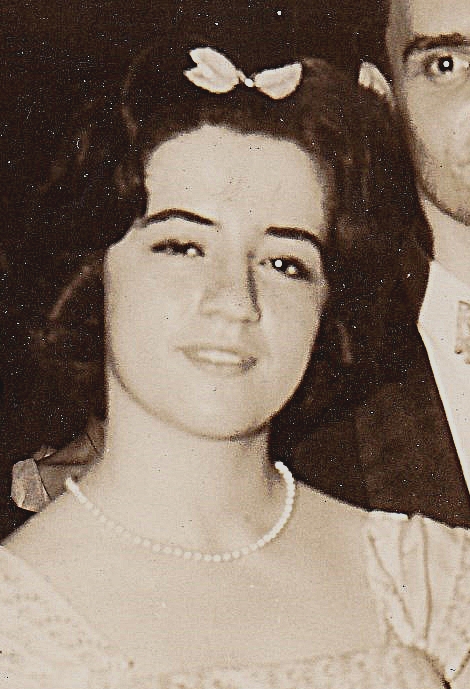
Senior prom, 1962

Wednesday, February 14, 2018

Paleo Nights

In tribes who still live much like our Paleolithic ancestors, people don’t sleep through the night. Soon after dark, they climb into their hammocks in the smoky communal hut and fall asleep, then get up a couple of hours later to add wood to the fire, nurse babies, or make more babies. Then they go to sleep again.

Some researchers maintain that the concept of eight hours of uninterrupted sleep is an artifact of the post-Edison era, an expectation that leads to frustration, anxiety…and insomnia.

I used to be a sleep athlete. Once my head hit the pillow, or the headrest of the car or the airplane seat, I was asleep within seconds. But those few seconds were so delicious that I used to wish I could prolong them. And waking up in the morning I would regret that during all those hours of lovely sleep I had been, well, asleep.

A memory: I am seven years old and getting over a bad case of measles. The doctor tells my mother that she needs to get me out of Barcelona and into the country to breathe fresh air and regain the kilos I have lost. So in spring, in the middle of the school year, my mother packs our suitcase, we kiss my father goodbye, and we take the train to my grandparents’ farm.

I have many reasons for rejoicing, being away from my scary German nuns and my even scarier classmates. I can step out of the farmhouse and, without having to hold anyone’s hand, cross the courtyard, stop to pat the chained up Irish setter who is only let loose in hunting season, then turn the iron ring that unlatches the heavy, weathered wooden door, and take myself for a walk on the dusty road that borders the wheat field.

But the best memory of those weeks is the orxata d’ametlles * that my mother brings me in bed at dawn. This super-rich almond milk takes time and muscle to prepare. First the hard, pitted shells of the almonds, harvested the preceding fall from my grandparents’ trees, have to be cracked with a hammer. My mother or perhaps my grandmother then blanches the almonds, slips off their skins one by one, grinds them in a mortar, strains them through an old linen napkin, and seasons the resulting liquid with cinnamon and a little lemon zest.

At first light, my mother glides into the bedroom and wakes me. With my eyes half closed, I slurp the orxata through a straw—a real straw from the haystack, yellow and shiny and vaguely redolent of summer grass. The orxata, sweet, thick and a bit floury, feels like a dream in my mouth.

But better even than the lingering flavor of almonds is my mother pushing me back down onto the mattress, pulling up the covers, and tiptoeing out of the room. This  allows me to savor, twice in a single night, the pleasure of falling sleep.

The  orxata did its work, my mother and I returned to Barcelona, and those dawn interludes became a thing of the past. For decades after that, except for the short periods when I had babies to nurse, I slept for eight, ten, or twelve hours at a stretch, every single night.

But not any more.

Now I have to coax sleep to come to me, as if it were some shy wild creature. I practice state-of-the art sleep hygiene. I go to bed at the same time every night. I take a couple of herbal supplements for their real or placebo effects. The bedroom is a temple of Morpheus, dark and on the cool side. There are no TVs or laptops or phones--just a slumbering spouse, the cat Telemann, Bisou, the dog, and me, counting my breaths.

Sometimes my strategies work, but often they don’t. Some nights my yet-to-be-replaced left hip hurts, and I have to keep changing position. Some nights nothing hurts, and I still can’t fall asleep.
Eventually there’s nothing for it but to get up, find my glasses, and sneak out of the room. I pad to my study and turn on the lamp. Through the window, I can see the moon shining on the snow. The house is very quiet.

Now what?

Soon Telemann and Bisou join me, and then it gets a bit crowded in my narrow recliner. After an hour or so of reading or staring at the moon I lead the way back to the bedroom. Telemann and Bisou go back to sleep, and so do I.

What is so terrible about this? Why can’t I learn to like my weird new nights?

I resent it that sleep, once reliable as a well-trained dog, no longer comes when called. I miss the blessed confidence that, no matter what was going on in my life, I could blot it out by turning out the light and pulling the covers up to my chin, consigning my anxiety/nervousness/sadness to temporary oblivion. Sleep was a harmless but effective drug, always within reach, one that didn’t need a doctor to authorize refills.

What, I wonder, did my Paleo ancestor do—the one who wasn’t up nursing or making babies? Did she fret about the wolves howling in the distance? Did she revisit old sorrows, guilts, and regrets and wish that she could make them vanish by going back to sleep?

Or, being a wise old woman with a touch of early Zen in her philosophy, did she throw another log on the fire, pull her blanket over her shoulders, and stay present with her feelings as the moon moved across the sky?


*orxata d’ametlles (horchata de almendras in Spanish) is the Catalan term. You can find a version for contemporary kitchens here.

Friday, October 20, 2017

Some Things I Miss...

Some things I miss from my previous life:
Two goats
Ten hens
Nine garden beds
Four apple trees
A sloping hay field
A tumbledown stone wall
A swamp
The woods behind the house, and the thrush that sang in them
The imprint of fawn hooves on the driveway in mud season
The squeaky-door song of the phoebes at dawn
The frogs in the frog pond
The black bear at the bird feeder
The ermine in the garage
The milking pail, the cheese press
The me who believed she could keep it all going.

(photo by Alison Cobb)

Friday, April 3, 2015

Bisou Loses Three Friends

During the ten minutes or so that it took my spouse and me to decide to move to Wake Robin, we asked the resident couple with whom we were having dinner if they could tell us one thing they did not like about the community.  The woman shook her head--she couldn't think of anything--but her husband said "Yes, there is one thing:  you make friends with people, and then they die."

Now, barely four months into her therapy dog practice in Linden, Wake Robin's nursing care facility, Bisou has lost some of her best friends.

On our weekly visits, not everyone reacts to Bisou with the same degree of enthusiasm.  Some people are too ill to do much more than give her a silent smile and a tentative pat.  Others are more interested in talking to Bisou's human retinue, especially to the young male staff member who accompanies us and on whom they dote with grandparently affection. 

But you can always tell the dog people.  Their faces light up as we come in the room and they pat their knees and invite Bisou up into their laps.  She looks into their eyes and they go into rhapsodies, telling her what a good girl she is, how smart, and what beautiful long red ears she has.  Then they tell her about the dogs they used to have.  Long-dead German Shepherds, Cocker Spaniels, Irish Setters, Labs, and Poodles big and small come back to life in these conversations, walking the kids home from school, retrieving pheasants, wolfing down a stolen box of cookies.... Bred to be a good sport, Bisou listens and lets herself be held.  When it's time to go she hops down and walks out of the room, nose to the ground, hoping for an errant crumb.  The dog lovers keep their eyes on her as she leaves.  "Look at that tail," they exclaim.  "It never stops!"

Over the last few weeks, three of Bisou's most affectionate admirers have died.  One week they were there, frail but dressed and sitting up, asking her for kisses, telling stories, oblivious to the red and gold hairs that she shed on their clothes.  And the next week they were gone, and the doors to their rooms, which used to be decorated with posters and photos and signs saying "Visitors Welcome!"  were closed.

It isn't easy to walk with Bisou past those newly closed doors.  But I'm grateful that I have her to keep me from taking comfort in the veil of secrecy with which our culture surrounds the end of life.  I know that the pleasure that our visits bring to the residents of Linden is only a small and momentary thing.  But while we're there, Bisou sitting on a narrow lap, me kneeling on the floor and trying to keep her from sliding off, we are fully invested in the moment which, in the end, is all that the resident in her wheelchair, Bisou with her wagging tail, and I really have.

Tuesday, March 24, 2015

Some Advice On Downsizing

Last spring at about this time I was in the throes of preparing to move to Wake Robin. It was the downsizing of a lifetime, the move before the final move to that tiny house that awaits us all--you know, the one where there’s no room to even stand up, not that we will want to stand up then.

Over three months, a constant torrent of stuff streamed out of our house--forty-eight boxes of books, some wooden spoons, a pressure cooker, my graduate school notebooks, a coin collection, the cheese press my husband made for me....  The books went to the library sale;  the pressure cooker and the coin collection went to the auction;  and I gave away the cheese press.  The grad school notebooks I guiltily jettisoned into the rental dumpster that decorated our yard.

Now, with the wisdom of hindsight, I feel qualified to pass on the following advice to those of you who are contemplating a similar move or are simply feeling trapped by too much stuff:

Don't give yourself a lot of time.  It’s going to be agony no matter how you do it, so take a deep breath and rip off the band-aid in one swift yank.


Remember that you are not your possessions.  More than that, your dearly departed--your mother who gave you that vase, the friend who painted that picture--are not that vase, or that picture.  They are not even IN the vase or the picture.  They are in your memories, and in your heart.  It's o.k. to let go of the things they left behind.
Don’t foist your treasures on your descendants.  It’s not their fault that on your wedding day you received seven silver nut dishes for which you have no use or space.  It’s not their fault that in a moment of madness you spent half your rent money on that oak Victorian desk.  They have no space for the desk, and they are too busy to polish silver.  Possibly they have never liked the dishes or the desk.  Taste in furnishings is not necessarily transmitted in the DNA.  Don’t take it personally.
If you decide to sell things, don’t expect to get for them anything near their real value, let alone the sentimental worth that they have accumulated for you over the years.  In this day of cheap goods, we are all drowning in material possessions.  Selling your things for a pittance, or giving them away, is the price you pay to have them disappear from your life, and it's a small price for the relief you will feel.
Trust me when I say that most objects, once you let them go, you will never miss.  You may never even remember them.  You think you’ll never be the same without your blue glass canning jars?  Go ahead and wrap them in newspaper, put them in a box from the liquor store and send them to the auction.  Once they’re out the door, if you ever think of them again it will be with the same serene fondness with which you now recall that boy you loved so desperately in high school, and the broken heart you thought would never mend.

(Sorry for the weird formatting--I can't seem to be able to fix it.)

Thursday, March 19, 2015

The Crow And I


Isn't it funny how we age, not in a uniform manner, but bit by bit, haphazardly?  To me, it feels as if a bird were flying around me, brushing me with its wings and occasionally pecking at me.

My personal bird-of-aging is a crow, and not unattractive, with its blue/black plumage and clever yellow eyes.  I can hear its wings beating above my head and sometimes I catch a glimpse of it out of the corner of my eye.  Occasionally it flies so high that I think it's gone away for good.  But it comes back as faithfully as a well-trained falcon.

Some days it pulls out a few of my hairs, but with such a delicate touch that my scalp doesn't feel a thing.  It makes regular passes over my hands, thinning the skin and fattening the veins.  Lately it's been pecking at my lower back:  until a few weeks ago I could roll out of bed in the morning, bend over and touch my toes.  Now I can still do this, but not until after breakfast.  I used to sleep like a log, no matter what was going on in my life.  Exams, job interviews, the onset of labor--nothing kept me from my date with Morpheus.  But now the black bird comes into my bedroom at night and flits and preens and fluffs its feathers, and makes me toss and turn.

Yet my feelings towards this crow are not unfriendly.  I've gotten used to its comings and goings, to the way it peers at me with its bright yellow eyes, head tilted to one side, planning which part of me it will touch next.  I have accepted this inevitable companion.

My animal escort reminds me that I am an animal too, vowed to the same end as the field mouse whose dessicated remains Bisou retrieves from under some leaves at winter's end, or the deer whose jawbone Wolfie fetches proudly out of the woods.  The mouse, the deer and I were cared for by our mothers, loved our children and feared our enemies in ways more similar than we humans like to imagine.  And like the mouse and the deer I will, mercifully, not go on forever.  With my crow leading the way, I will walk the path of my last days until, like the creatures of the sky, the fields and the woods, I become one with the Mother of us all.

Monday, March 9, 2015

What Wisdom, Where?

When eating organic/vegetarian/gluten free, working out at the gym, and drinking eight glasses of water a day cease to delay the inevitable, baby boomers console themselves by thinking that, although age does not improve one's looks, at least it makes one wiser.

We've all heard how, having ceased to strive for mates and worldly success,  no longer driven by the urge to please others, we are finally free to be ourselves.  Some studies actually show that people become happier as they age.   Whether or not we've grown rich in money and offspring, we have all grown rich in experience, and thus qualify for the job reserved for elders in traditional societies since time immemorial:  the role of counselor, seer, and sage.

I cannot tell you how weird this makes me feel.  Whenever I hear my contemporaries yammering on about how much more serene, centered, and happy they are than they used to be, I wonder if I am retarded somehow, and if I have missed some crucial step in this final, blessed phase of life.

At seventy, I do not feel one speck wiser than I did in my thirties.  On the contrary, not only have I forgotten 85% of the things that I once knew, but the hole that that knowledge left behind, supposedly to make room for a new hoard of wisdom and discernment, remains a vacuum into which I daily stare, and shudder.

As for the role of counselor and village sage, don't make me laugh!  In my callow youth, if someone asked for my advice I jumped to give it. But now, if you ask my opinion on what you should have for dinner, I will be struck dumb.  Truffle-stuffed quail in puff pastry?  Beans and rice?  A simple cup of broth?  How can I answer when I don't know what's in that stuff, or what your body needs at this moment, or what beans feel like on your tongue.

To quote the man in the Vatican, who am I to judge?

As for being happier now than I was years ago, I am grateful that I don't have to shave my legs as often, but I can't think of too much else to be glad about.  Still, I can say that age has made me a little kinder. I am more understanding of people, less inclined to criticism or anger.  For one thing, anger takes energy, of which I have little to spare.  But mainly, my awareness of my own deficiencies makes it easier to forgive them in others.  Again, who am I to judge?

But maybe that's where it's at, in the end--not wisdom, or knowledge, or even Love with a capital L.  Just the homely, workaday practice of kindness.  No matter how much organic kale we eat, how many miles we run, or how deeply we meditate we are all headed downhill.  But as the light dims and the wind grows colder, we can at least aim to be good company for each other.

Monday, March 2, 2015

Zen and the Recorder


Now that I have entered my eighth decade, I am learning to play the recorder.  There is no time to lose, so I practice daily, much to Bisou's dismay.  The minute she sees me pick up the green plastic case that houses the instrument, she tucks her tail between her legs and leaves the room.  And I don't blame her--the squeaks and whistles I produce often make me want to leave the room.
 
But as if the noises weren’t bad enough, there is an additional humiliation:  spit.  When an inexperienced player such as I puts the instrument to her lips and begins to blow, saliva escapes into the mouth piece, adheres to the inside of the pipe, and does terrible things to the sound.  With the exception of occasional lapses during deep sleep, I haven’t salivated involuntarily since I got my first teeth.  And now here I am, practically a century later, drooling helplessly into my recorder.

Like one of Pavlov’s dogs at the sound of the bell, the minute I start to play my salivary glands go into overdrive.  This happens especially during a lesson, or while I play a duet with one of my recorder buddies.  We all know that stress triggers bad things, from headaches to heart attacks.  For recorder players, stress triggers salivation, and viceversa.  Sure enough, as soon as I hear that half-choked, reedy sound that indicates the presence of moisture in the pipe I go into alarm mode, which in turn raises my stress levels and causes rivers of spit to gush into my instrument.

“What can I do about this awful drooling?” I asked my teacher after a particularly cacophonous session.

“Just relax and accept it,” she said, sounding more like a Zen master than a recorder instructor. “Here, try reaming it out with this,” she added, handing me a cylindrical swab.

And she was right.  The swab helps, but the real key lies in my mind and in my heart.  The more I make peace with my salivary glands, the less they feel they have to assert themselves.  Sometimes I manage to play an entire piece without having to swab.  But if, in the middle of a passage that is going well, I think to myself “wow, this sounds pretty good!” the spit instantly pours forth.  It is not unlike what happens to me in meditation when, for a few fleeting moments, I manage to stay with the breath.  As soon as I begin to congratulate myself, my monkey mind leaps into action and all is lost.

My teacher assures me that with time the spit problem will get better, though it may not go away completely (that is why they make those special swabs).  Until then, it seems that the best technique is a spiritual rather than a musical one:  I have to stay open to the possibility of drools and squeaks, errors and embarrassment, and keep on making music as best I can.

Followers